

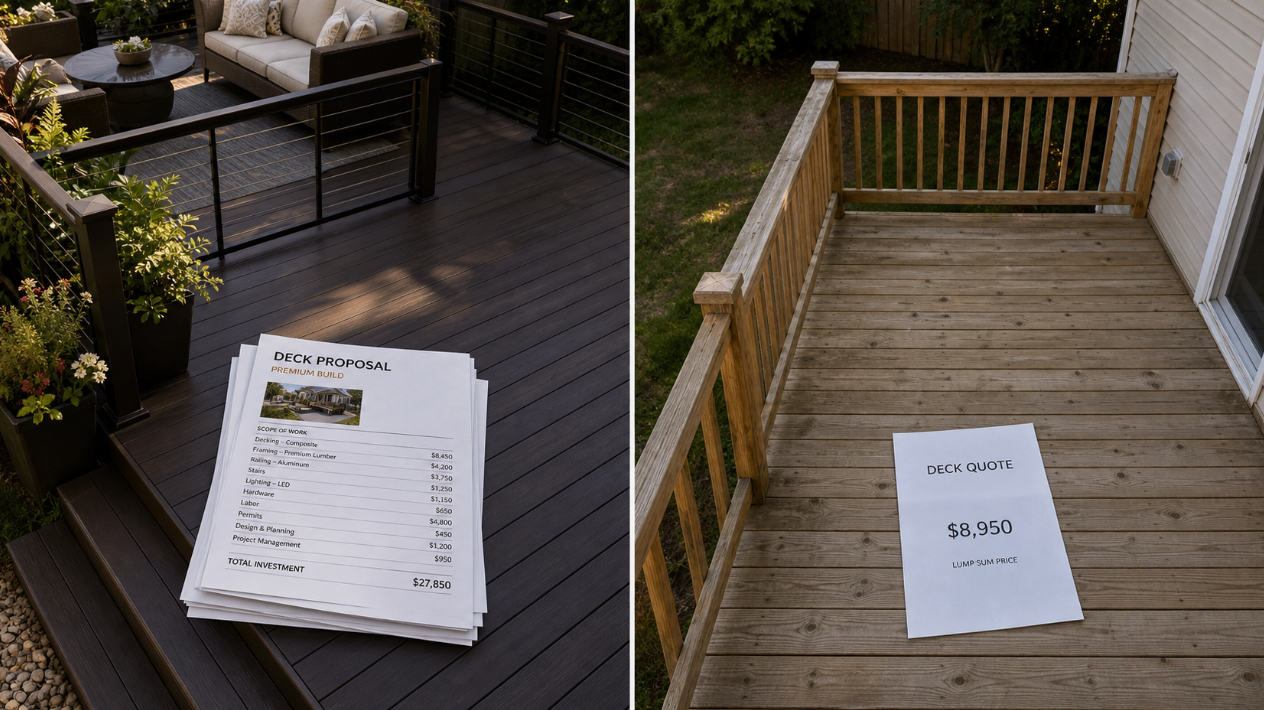
You get two quotes for the same deck. One is $14,200. The other is $20,800. Same square footage, same composite material, same railing style listed on paper. So what exactly is going on? The answer isn’t that one contractor is ripping you off. The difference is in what each proposal actually includes, and more importantly, what the cheaper one quietly leaves out.
When people search for the best deck companies near me, they usually hope to find someone reliable at a fair price. But “fair” is hard to judge when proposals aren’t apples to apples. This guide breaks it all down.
What a Deck Proposal Actually Contains
First, let’s get some terminology straight. An estimate is a rough ballpark. A quote is a fixed price. A proposal is a full document that outlines scope, materials, labor, timeline, permits, and warranty. If a contractor hands you something that looks more like a Post-it note than a proposal, that’s already a problem.
A solid proposal should cover at minimum: what’s being demolished or cleared, what materials will be used (brand, product line, color), how the structure is framed, how footings are handled, permit and inspection details, payment milestones, project timeline, and warranty terms.
If you get a lump sum with no breakdown, like “16×20 composite deck with railing, $17,500,” that’s not a proposal. That’s a number. And a number without detail is a blank check for the contractor to decide what “the deck” actually means once the job starts.
Materials: Where the Price Gap Starts
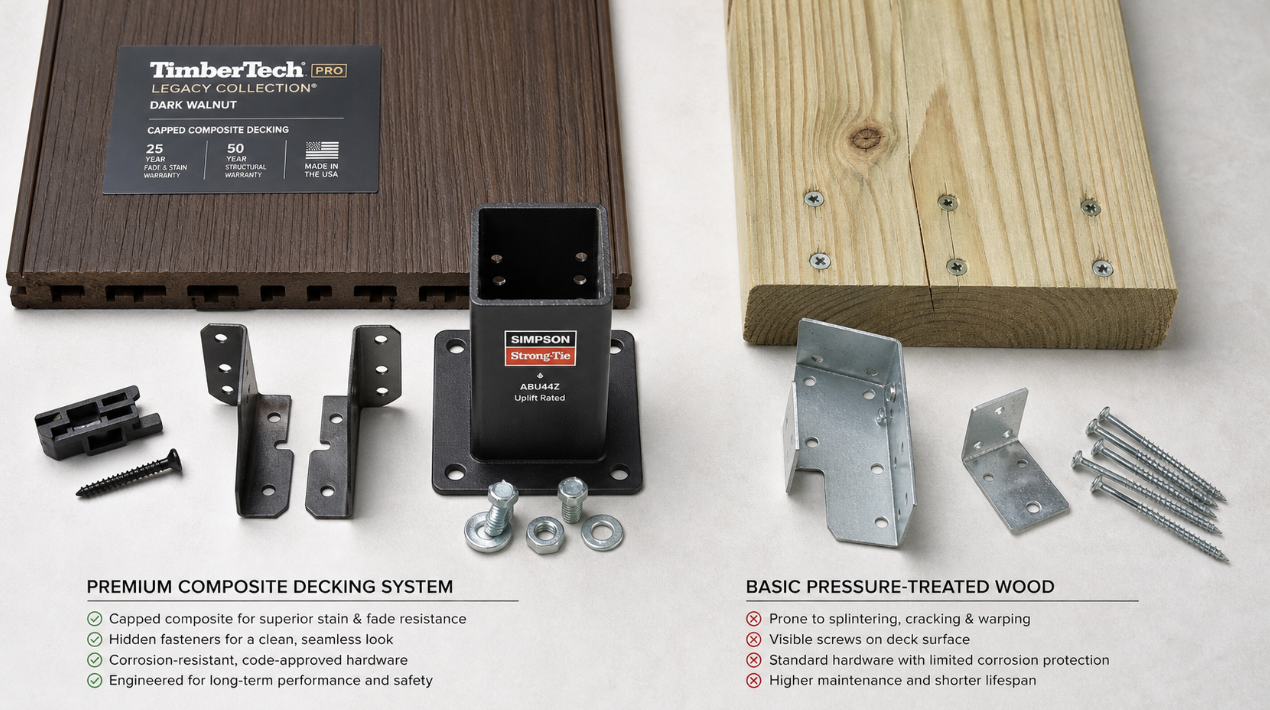
This is often the biggest hidden difference between a budget and a premium bid. Entry-level composite decking runs around $3 to $5 per linear foot. Premium product lines from brands like Trex Transcend, TimberTech Azek, or Fiberon Premia sit closer to $10 to $15 per linear foot. On a 400 sq ft deck, that gap alone can hit $3,000 to $6,000 before anyone picks up a hammer.
The best contractors don’t write “composite decking” on their proposals. They write Trex Transcend, Tiki Torch, Grooved Edge, 1″ x 5.5″. Budget companies write “composite decking.” That’s it. No brand, no grade, no series. It gives them the freedom to swap in whatever’s cheapest when they show up to work.
The same applies to hardware. Joist spacing, blocking, hidden fasteners vs. face screws, structural joist hangers rated for your specific framing load, post bases with uplift resistance. All of these matter. None of them is visible once the deck is done. Budget proposals skip them entirely or lump them into vague “framing” language.
Structural Line Items Budget Contractors Skip
Here’s where things get serious. The pretty part of a deck is the surface. The important part is everything underneath.
Some structural items that often disappear in low-ball proposals:
- Footing depth (especially in frost-prone states where you need to go below the frost line, not just minimum code)
- Footing diameter (smaller footings cost less concrete and carry less load)
- Ledger flashing (the #1 cause of deck moisture damage and eventual structural failure)
- Blocking between joists for lateral stability
- Permit and inspection fees
- Demo and debris removal of the old deck
Building the code below is cheaper on paper. It’s also a liability the homeowner inherits the moment something goes wrong. Inspections protect you, not the contractor. When a budget company quietly leaves permits out of scope, they’re also skipping the inspection that would catch anything done wrong.
Site prep and cleanup are another sneaky omission. You might find out after signing that hauling away your old deck costs extra. Or that grading around new footings isn’t included.
Labor Standards and Crew Experience
The people building your deck matter. Experienced crews work faster, make fewer mistakes, and produce cleaner work, especially on details like railing post alignment, stair stringers, and hidden fastener runs.
Top-tier companies use milestone-based payment schedules. You pay when the demo is complete, when framing is done, when decking is finished, and at final sign-off. That structure protects both sides.
Budget contractors often ask for 50% upfront. That’s a red flag. Once they have half your money before breaking ground, your leverage drops significantly. And vague labor line items like “installation: $4,200” with no breakdown mean you have zero protection against change orders showing up mid-project. “That wasn’t in scope” becomes a very expensive phrase.
Warranties: The Fine Print Nobody Reads
There are two completely different things people confuse here: the manufacturer’s warranty on the materials, and the contractor’s workmanship warranty on the installation.
Most premium composite products carry a 25 to 30-year warranty from the manufacturer, but that warranty is only valid if the product is installed according to their specs. Wrong joist spacing, wrong fastener type, wrong gap between boards? The manufacturer voids the warranty and you’re on your own.
Budget companies often mention a “limited warranty” without explaining what it covers, for how long, or what the process is if something fails. The best contractors spell out exactly what’s covered under workmanship, for how many years, what’s excluded, and what the service call process looks like. That’s a document you should ask for before signing anything.
How to Read Proposals Side by Side
The trick to comparing quotes fairly is normalizing the scope. If one proposal doesn’t include permits and the other does, add the cost of permits (typically $500 to $1,500 depending on your area) to the cheaper bid before comparing totals.
As a quick sanity check, divide the total cost by the square footage. In 2026, professionally built decks typically run $15 to $45 per sq ft, depending on materials and complexity. If you’re getting a quote below $15, something is missing. If it’s above $45 for a straightforward build, ask for justification.
Here’s a basic checklist to run through every proposal you receive:
| Line Item | Proposal A | Proposal B |
|---|---|---|
| Demo & debris removal | Included | Not mentioned |
| Permit & inspection | Included | Not mentioned |
| Ledger flashing | Specified | Not specified |
| Footing depth & diameter | Defined | “Per code” only |
| Framing lumber grade | #1 PT | Not specified |
| Joist spacing | 12″ OC | Not specified |
| Decking product (brand/line) | Trex Transcend | “Composite” |
| Railing product | Specified | “Aluminum railing” |
| Stairs | Included, detailed | Included, vague |
| Cleanup | Included | Not mentioned |
| Workmanship warranty | 5 years, written | “Limited” |
If a contractor refuses to break down their proposal into line items like this, that refusal is itself an answer.
Red Flags in a Budget Proposal
Not every cheap quote is a scam. But there are specific patterns that consistently signal problems ahead:
- Lump sum with no line items or structural specs
- Materials listed by category only, no brand or product line
- 50% or more required upfront before any work begins
- No permit listed anywhere in the scope
- Proposal expires in 24 to 48 hours (“sign today or lose this price”)
- No mention of flashing, moisture control, or blocking
- Warranty terms that say “limited” with no further explanation
That last one on the urgency pressure is worth flagging specifically. Material costs don’t change overnight. Labor rates don’t expire at midnight. If a contractor is pushing you to sign fast, they’re trying to cut off your ability to compare.
What the Best Deck Companies Near You Include That Others Don’t
When you actually find one of the best deck companies, their proposal looks different from the first line. It reads like a construction document, not a sales receipt.
The price is higher, yes. But it’s higher because it includes things the budget quote left out: the permit, the correct footing depth, the ledger flashing, the premium framing hardware, the specific product spec. When you add those missing items back into the cheaper quote at market rate, the gap between “expensive” and “cheap” usually shrinks considerably, and sometimes disappears entirely.
Before you sign anything, ask every contractor for a fully itemized proposal with product specs, structural details, and written warranty terms. Any company worth hiring will have no problem providing that. The ones who push back or stall? They just told you everything you need to know.
