

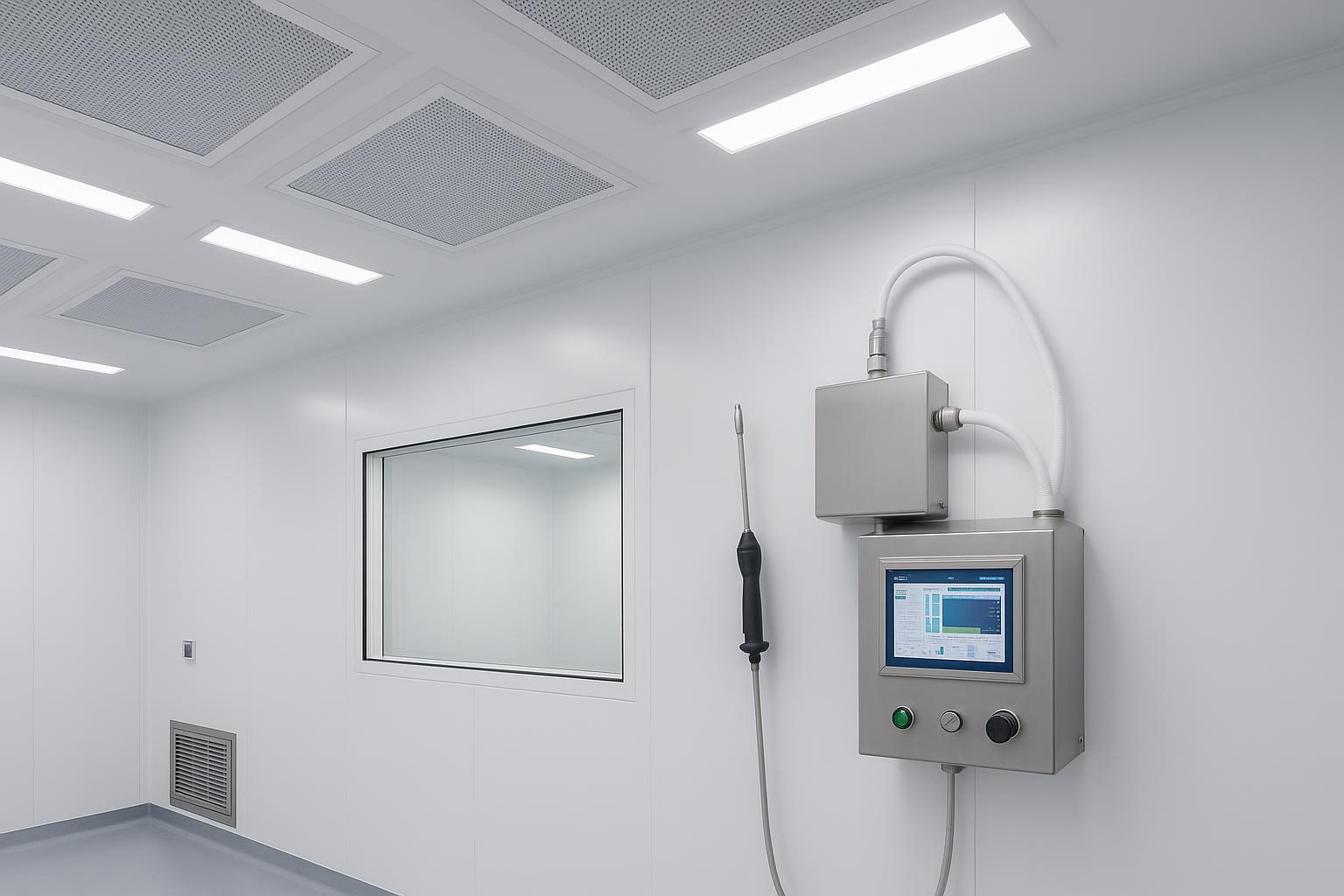
HEPA filter integrity testing should demonstrate that the installed filter, frame, gasket, housing, and surrounding seal do not allow unacceptable bypass leakage under an agreed operating condition. It is an installation-level test, not a repeat of the filter manufacturer’s efficiency certificate.
That distinction matters at handover. A filter can leave the factory with a valid report and still be damaged in transport, seated incorrectly, compressed unevenly, or installed in a housing with a leak path. If the acceptance plan checks only the filter label and the room particle count, the project may miss a local defect that can later undermine contamination control.
Treat the test as a system handover gate
A useful integrity-test protocol begins before ceiling closure. The designer, installer, commissioning team, and owner should agree on which filters are in scope, how the upstream challenge will be introduced, where the upstream concentration will be sampled, how the downstream face and perimeter will be scanned, and what acceptance criteria apply. Access is not a minor detail: lights, diffusers, service frames, and equipment can make a complete scan difficult if the test method is considered too late.
The current ISO 14644-3:2019 standard provides cleanroom test methods, while the FDA’s aseptic-processing guidance describes the importance of installed HEPA-filter leak testing in critical areas. The project protocol should identify the governing standard, the agreed room state, the instruments, and the owner’s quality-system requirements rather than relying on a generic statement such as “DOP test included.”
DOP and PAO describe the challenge aerosol, not the whole method
“DOP test” remains common market language. Many current protocols use polyalphaolefin (PAO) instead of legacy dioctyl phthalate formulations, but changing the aerosol name does not by itself make a test rigorous. A defensible test also needs a stable and measurable upstream challenge, calibrated instruments, an appropriate scan pattern and speed, access to the filter face and perimeter, and a documented response when a leak is found.
The technician challenges the upstream side and scans downstream for local penetration. The scan must cover the media, frame, gasket or gel seal, housing interface, and other potential bypass points. This is different from a room particle-count classification test. Particle counting asks whether the room meets an airborne concentration limit under a defined state; integrity testing asks whether the installed filter assembly contains local leak paths.
Seven records a buyer should receive
- A filter schedule that connects every test result to a room, terminal location, and unique filter ID.
- The applicable procedure, standard reference, room state, airflow condition, aerosol type, and acceptance criteria.
- Calibration status and identification for the aerosol generator, photometer or particle-counting equipment, and related instruments.
- The measured upstream challenge and evidence that it remained suitable while the downstream scan was performed.
- A scan record that covers the media and the complete perimeter, not a single downstream spot reading.
- A deviation log showing leak location, diagnosis, repair or replacement, and the result of the repeat test.
- An approved final report linked to commissioning, qualification, and the preventive-maintenance or recertification plan.
Efficiency grade and installed integrity answer different questions
The selection between H13 and H14 HEPA filters is a performance and system-design decision. The installed integrity test then verifies that the selected assembly has not been compromised by its frame, seal, housing, handling, or installation. Specifying a higher filter grade cannot compensate for a poor housing seal, blocked scan access, unstable airflow, or missing documentation.
When a leak is detected, the response should be governed by the approved protocol. Some issues may be corrected by reseating or repairing a permitted seal area; damaged media or recurring housing defects may require replacement or redesign. Every correction should be recorded and followed by a repeat test. A pass without a traceable repair history is not a strong handover record.
FAQ
- Is a factory certificate enough? No. It does not cover shipping, installation, housing, or seal condition.
- Is a room particle-count test the same? No. Integrity testing finds local bypass; classification measures room concentration.
- When should it be repeated? Follow a risk-based schedule and retest after filter replacement or a change that may disturb the assembly.
