

Dr. Boutros Mikhail is a Toronto-based physician and general practitioner with more than two decades of experience delivering patient-focused care across hospital, clinic, and emergency room settings in both urban Ontario and rural Newfoundland. His clinical background spans dermatology, cardiology, endocrinology, and chronic disease management, supported by a diploma in pediatrics from Cairo University, a distinction diploma in Practical Dermatology from Cardiff University, and certifications including advanced cardiac life support and family medicine cognitive behavioral therapy. A member of the Ontario Medical Association and a fellow of the College of Family Physicians of Canada, Mikhail has treated thousands of patients and mentors medical students at the McMaster University Faculty of Medicine. That broad clinical grounding, including firsthand experience in resource-limited rural settings, informs how emergency teams triage, stabilize, and determine when a patient requires transfer to a higher level of care.
Emergency care is not administered under the same conditions everywhere. A large urban hospital may have specialists, comprehensive imaging equipment, admission beds, and several teams nearby.
A rural or community emergency department may have fewer on-site services and longer transport distances. Those differences do not make local care less important, but they can affect what clinicians treat on site and how they assess, stabilize, and transfer patients.
Resources include the staff, equipment, space, tests, medications, and transport options available during care. In an emergency department, that may mean nurses, physicians, treatment rooms, ambulances, testing, or specialist backup.
Defining those resources matters because a smaller site may provide first-contact assessment and treatment while relying on a larger hospital for more resource-intensive care.
Triage involves prioritizing patients according to clinical urgency rather than arrival order. The assessment considers symptoms, vital signs, mental status, pain, medical history, injury mechanism, and the risk of deterioration.
Warning symptoms such as signs of stroke, severe chest pain, major bleeding, loss of consciousness, severe breathing difficulty, shock, major trauma, anaphylaxis, or serious infection may require immediate intervention.
Triage is ongoing, and a patient’s condition or priority may change while they wait. Anyone whose symptoms worsen should alert triage staff immediately.
Once clinicians identify an immediate threat, the focus shifts to action.
Stabilization means addressing immediate threats while the team simultaneously determines whether the patient can remain locally or requires urgent transfer. A team may protect the airway, support breathing, control bleeding, administer fluids, monitor the heart, or give urgent medication.
Stabilization does not always mean that every problem has been resolved. Some patients require transfer while treatment and close monitoring continue.
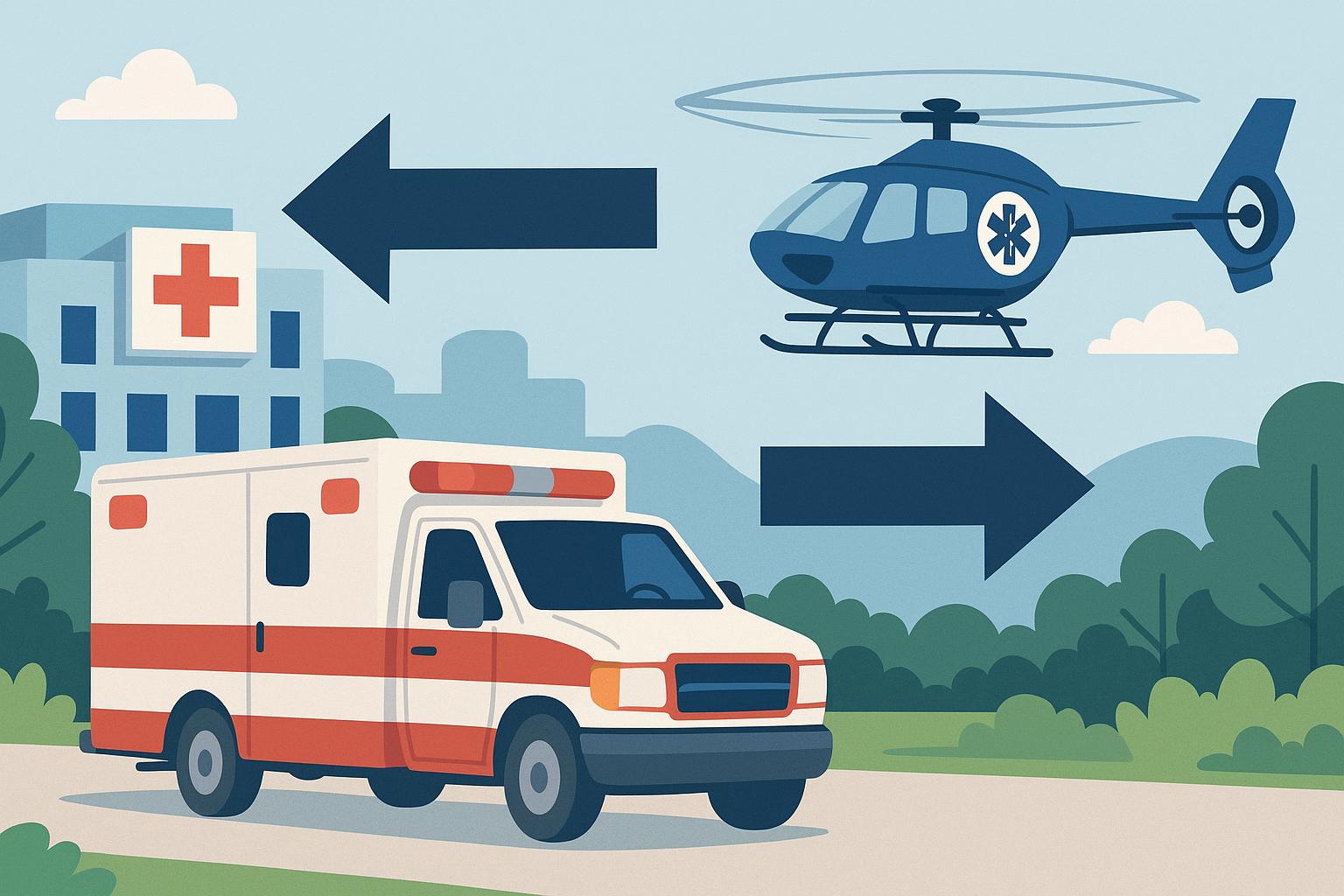
Transfer may be arranged when the expected benefit of care at another facility outweighs the risks of remaining locally and the risks associated with transportation. The decision considers the urgency of definitive care, the local site’s capabilities, the patient’s current condition, transportation risks, receiving-facility acceptance, and the appropriate mode of transport.
The sending team prepares the patient, communicates the concern, documents key information, and coordinates with transport and the receiving facility.
Transfer information should include the diagnosis or leading concern, current condition, allergies, medications, test results, treatment provided, and anticipated risks.
Responsibility remains with the sending team until an appropriate transfer of care occurs.
Clinicians can keep care local when the patient is stable and the needed assessment, treatment, monitoring, and follow-up fit the setting’s capacity.
Some clinically stable, non-life-threatening conditions may be treated in urgent care or another community setting when a healthcare professional recommends that level of care. Suitability depends on the individual condition and the service’s capabilities.
Patients should not delay emergency assessment when symptoms are severe, rapidly worsening, or difficult to interpret. The safest option depends on clinical need—not simply geography, convenience, or hospital size.
Limited-resource care also depends on support beyond one exam room.
Nurses, physicians, allied health professionals, ambulance teams, virtual specialist support, and receiving hospitals form an emergency-care network.
Remote consultation may help a local team confirm risk or plan treatment, but it cannot replace transfer when hands-on specialized care is required. This network also helps arrange transport, prepare the receiving site, and keep follow-up connected after the patient leaves.
Family physicians often support rural emergency care, although staffing models vary. Rural hospitals may depend on clinicians who provide comprehensive care while working with allied health professionals.
The broad clinical training of rural family physicians can help them recognize how chronic disease, pregnancy, medication use, infection risk, and other patient-specific factors may affect an acute presentation. Recognizing emergency risk, however, is a shared responsibility across the care team and is not limited to one type of clinician.
Communication follows each medical decision.
Patients and families need to know what the local site can do, why a transfer may be needed, what the team is monitoring, and which symptoms require immediate attention.
If the patient goes home, discharge instructions should explain follow-up timing, medication changes, outstanding tests, and who is responsible for reviewing and communicating pending results. The clinician who orders a test generally remains responsible for tracking and acting on the result unless another clinician explicitly accepts that responsibility.
Clear communication keeps the next step connected to the care the team provided.
Coordinated emergency care depends on each stage connecting safely with the next. Triage should lead to timely assessment and treatment.
Stabilization should lead to continued local care or appropriately organized transfer. Discharge should include clear instructions, management of pending results, and any necessary follow-up.
A facility does not need to provide every specialized service to play a vital role in emergency care. Patient safety depends on recognizing limitations early, beginning appropriate treatment, communicating clearly, and transferring responsibility without avoidable delay.
About Dr. Boutros Mikhail
Dr. Boutros Mikhail is a Toronto-based physician and general practitioner with more than two decades of experience in hospital, clinic, and emergency care settings across urban Ontario and rural Newfoundland. His background spans dermatology, cardiology, endocrinology, and chronic disease management, supported by training from Cairo University and Cardiff University and certifications in advanced cardiac life support. A fellow of the College of Family Physicians of Canada, he also mentors medical students at the McMaster University Faculty of Medicine.
