

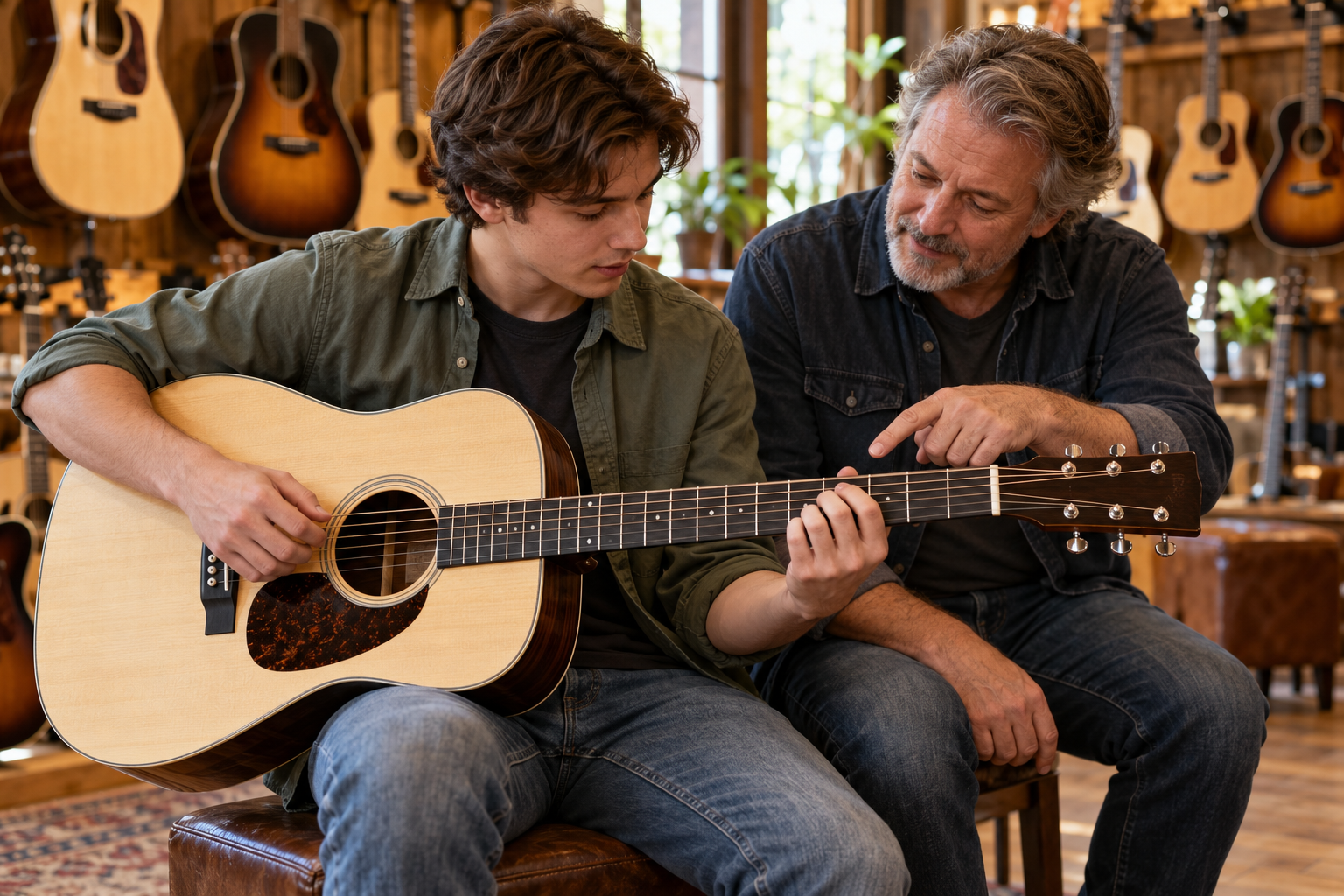
Buying a first guitar can get complicated surprisingly fast. There are dozens of brands, countless models and enough arguments about tonewoods, pickups and hardware to keep guitar forums occupied indefinitely. Beginners can easily assume that a higher price automatically means a better instrument, or that they need professional-level equipment before they have learned their first handful of chords.
Experienced guitar players tend to offer more practical advice. A quality guitar should feel comfortable, stay in tune, sound good and make a player want to pick it up again tomorrow. Beginners do not necessarily need an expensive instrument. They do need one that works well enough that the guitar itself does not become an obstacle to learning.
Playability Matters From Day One
Seasoned players often tell beginners to pay close attention to how a guitar feels. A beautiful finish or famous name will not compensate for an instrument that feels unnecessarily difficult to play.
String height, commonly called action, can make a major difference. Strings that sit too high above the fretboard require more pressure, which can make basic chords frustrating for new players whose hands are still developing strength and coordination. Strings set excessively low can create buzzing and other problems. Neck shape, fret condition and overall setup matter as well.
This is also why experienced players often recommend having a new guitar properly set up. Adjustments to the neck, action and intonation can turn an acceptable instrument into one that feels substantially better. Beginners sometimes blame themselves for problems that are actually caused by poor setup.
Price Does Not Tell Everything
There are excellent guitars at several price points, and manufacturing improvements have given beginners more credible choices than players had in previous decades. The objective should be finding solid construction and dependable components rather than buying the most expensive guitar within reach.
Brand reputation can still provide useful context. For example, Epiphone guitars are known for offering accessible versions of many classic electric guitar designs, giving players an opportunity to explore established styles without immediately entering premium price territory. Other manufacturers take similar approaches, offering beginner and intermediate instruments influenced by their higher-end models.
Experienced players typically recommend checking the details rather than assuming every guitar from a familiar brand will feel identical. Look at fretwork, tuning stability, electronics and finish quality. Plug an electric guitar into an amplifier and test the controls. If possible, play several examples of the same model. Guitars are physical instruments, and two that look nearly identical on a website can feel noticeably different in the hands.
Choose for Your Music
Beginners frequently ask whether they should start with an electric or acoustic guitar. There is no universal requirement to learn one before the other. A better answer depends on the music the person actually wants to play.
Someone inspired by hard rock, blues or metal may be more motivated by an electric guitar. A player interested in folk, country or singer-songwriter music may naturally gravitate toward acoustic guitars. Starting with the instrument connected to the music that inspired someone to learn can make practice more rewarding.
Comfort matters here, too. Acoustic instruments often use heavier strings and can require more finger pressure, although string gauge and setup affect that experience considerably. Electric guitars usually require an amplifier or another way to hear the instrument properly, which adds equipment and expense.
Experienced players understand that motivation matters more than following an arbitrary learning sequence. A guitar sitting untouched in a case is not helping anyone improve, regardless of whether it was technically the “right” beginner choice.
Tuning Stability Is Nonnegotiable
Few things frustrate a new guitarist faster than an instrument that refuses to stay in tune. Beginners are still training their ears, so constantly changing pitch can make it harder to recognize how chords and individual notes should sound.
Quality tuning machines help, but they are not the only factor. The nut, bridge, strings and setup can all affect tuning stability. New strings may also need time to stretch before they settle.
Intonation deserves attention as well. A guitar can have open strings perfectly in tune but produce increasingly inaccurate notes farther up the fretboard if its intonation is poorly adjusted. This may not be obvious to someone shopping for a first instrument, which is another reason buying from a knowledgeable retailer or having the guitar inspected can be worthwhile.
Seasoned musicians also tend to recommend purchasing a reliable tuner early. Tuning before practice takes very little time and helps beginners develop a better ear from the beginning.
Buy a Guitar You’ll Play
Experienced guitarists can debate pickups, body construction, scale length and wood choices for hours, but beginners do not need to master every technical detail before making a purchase. The best first guitar is usually one that meets basic standards of construction and playability while creating genuine enthusiasm about learning.
Appearance should not be dismissed, either. If a particular body style or finish makes someone eager to grab the guitar every evening, that has practical value. Musical instruments are tools, but they are also personal objects that players may keep for decades.
The advice seasoned guitarists give beginners ultimately circles back to a simple idea: buy the best-playing instrument that reasonably fits the budget, have it set up correctly and choose a guitar connected to the music you love. Then stop shopping long enough to actually play it.
