

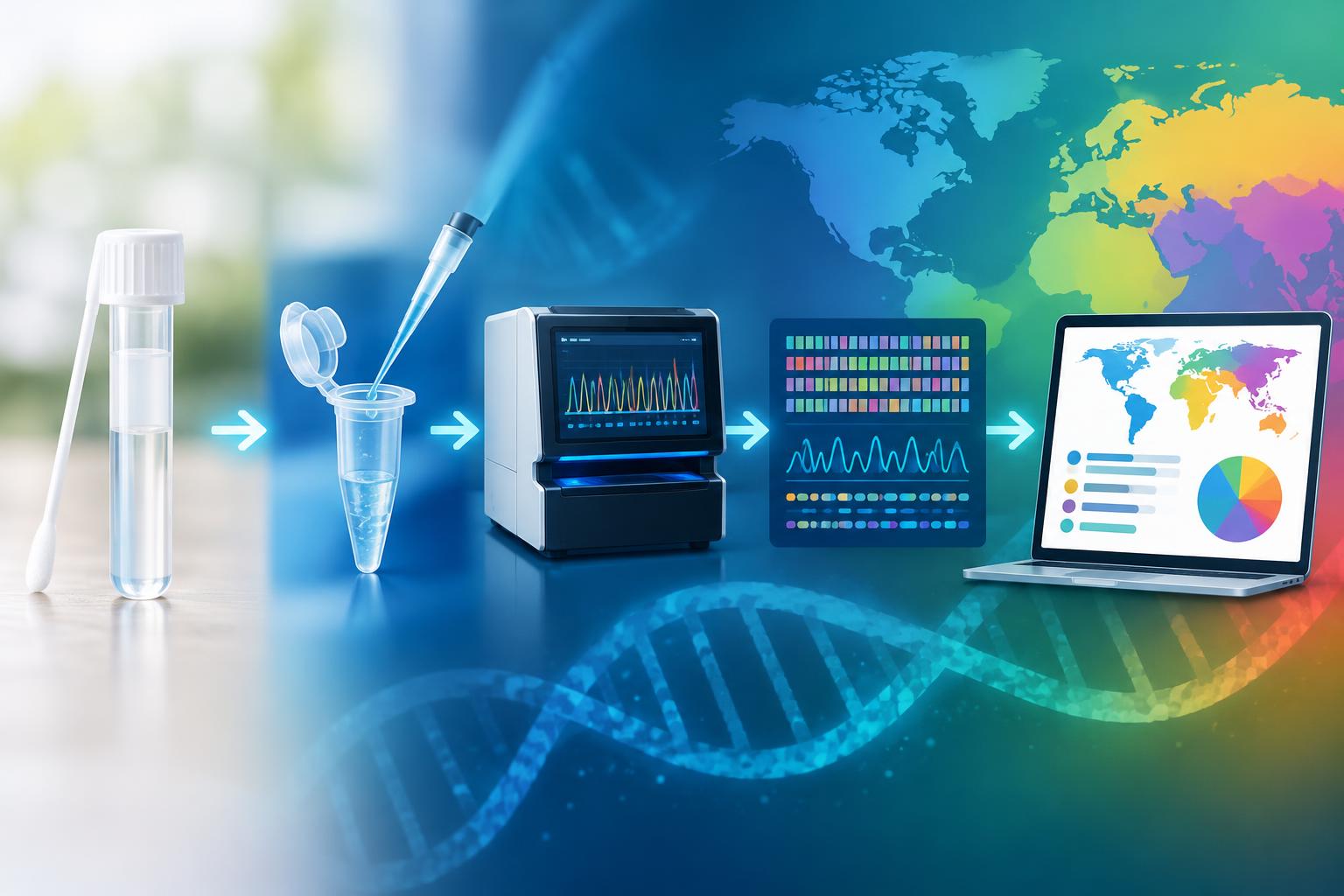
An ancestry percentage is the end of a process that includes laboratory measurements, data checks, and statistical comparisons. Understanding those stages helps explain why reports can change and why different findings carry different kinds of uncertainty. This article follows the reasoning behind the results and shows where family records still have a part to play.
A precise-looking result can still contain an estimate
A laboratory reading and an ancestry percentage can look equally definite on a results page. They are different kinds of information. One describes the genetic data obtained from our sample. The other is an interpretation made by comparing that data with selected reference groups. A later change to the percentage does not necessarily mean the laboratory measured something incorrectly. It may mean the comparison system changed. That distinction matters when a report appears to support a family story we have heard for years, or introduces a region we have never associated with our relatives.
Understanding a DNA test means following the reasoning between those two stages. We do not need to learn every formula to ask useful questions. Which parts of the DNA were examined? What comparisons produced the regional label? How much uncertainty sits behind the number displayed? Those questions help us appreciate what the science can reveal without expecting it to supply a complete family history. We can also separate confidence in a genetic reading from confidence in an ancestor’s birthplace. The first concerns measurement; the second requires more than a regional prediction. As we explore our results, that separation gives us a steadier way to handle surprises. We can take a new clue seriously while checking how it was produced. We can keep documented family connections intact when an estimate shifts. Most importantly, we can use the report to ask better historical questions, rather than letting a polished chart settle questions it was never designed to answer.
The laboratory supplies readings that software must interpret
A sample contains biological material, not a list of ancestral countries. The laboratory extracts DNA and obtains readings that can be analyzed. The exact method depends on the service. Keeping the laboratory stage separate from the later interpretation helps you judge claims about what a test actually examined. The sample type alone does not tell you how broad the analysis will be. Check the method described for the specific product rather than assuming every consumer service examines the same set of locations.
1. Identify what was measured
The National Institute of Standards and Technology describes microarrays capable of measuring millions of genetic locations at once. That describes the technology’s capability, not a universal marker count for consumer tests. A marker is a location whose variation can provide information for analysis. Reading more locations does not, by itself, establish that an ancestry label is more accurate.
2. Give quality checks their own importance
Readings need checks before they can support reliable comparisons. Missing or uncertain data can affect what is available to the software, so a large advertised count does not explain the whole process. Ask whether a number describes locations measured in the laboratory or a smaller selection used for a particular analysis. Those figures can differ without either being a false description of its own stage.
3. Separate observation from inference
A measured variant describes what was detected at a location; an inferred value is estimated using other information. Ancestry labels are another layer of interpretation built from comparisons and assumptions. Quality at one stage matters, but it cannot settle every question at the next. When reading a claim about accuracy, ask which stage was assessed and what evidence supports that assessment.
Reference groups give a model its choices and its limits
A reference panel contains selected samples used to represent ancestral populations. The regional model compares parts of your genetic data with those groups. Its labels depend on the categories available and how well they can be distinguished. A modern national border is not a genetic wall: neighboring populations can share patterns, and historical movement complicates neat divisions. This makes the composition of the reference panel important to the meaning of the result.
The important idea is that a regional label is inferred from patterns. Individual common variants do not serve as national name tags. Patterns across nearby locations provide more information, while the model has to handle competing explanations. A useful way to assess the output is to ask whether it distinguishes relevant neighboring groups and how uncertainty is reported. A larger panel may help without making every population equally well represented.
Validation asks whether a method performs well beyond the information used to build it. Results from separate testing data are more informative than simply showing that a model recognizes its own training examples. For a reader, the practical questions are about scope: which populations were assessed, which errors were counted, and which groups remained difficult to separate? The answer helps you interpret a percentage as a prediction with known limits rather than a direct measurement of cultural identity.
Inheritance explains why a match is not a named ancestor
Genetic inheritance gives relatives shared material, but the material does not arrive with names attached. Across generations, inherited DNA is reshuffled. Except for identical twins, siblings generally receive different combinations from their parents. They can therefore have the same family tree while carrying different genetic mixtures. Farther back, a documented ancestor may contribute no detectable autosomal DNA to a particular descendant. A family tree records relationships; a DNA result describes the inherited material available for analysis.
Relative-matching methods look for stretches likely shared through an ancestral connection. Similarity at a handful of common locations is not enough to establish that explanation. The pattern, extent, and quality of a reported segment matter. This is why matching involves filtering and interpretation rather than a search for a few identical readings. It is also why a service’s accepted matches should be assessed in context.
Shared DNA is often summarized in centimorgans, or cM, a measure of genetic distance related to reshuffling during inheritance. The reported total can help assess possible relationships, but relationship ranges overlap. A suggested cousin label does not identify a unique family path. Multiple ancestral connections can make the interpretation more complex. Ages, known relationships, and documentary evidence help distinguish the possibilities that the genetic result alone leaves open.
A regional estimate and a relative match therefore require different follow-up questions. For the region, ask what reference comparison supports the assignment and how uncertain it is. For the match, ask which documented family connection could explain the shared material. A match’s account may be managed by someone other than the person tested, so confirm whose result you are comparing. Neither inquiry requires dismissing the result because it is incomplete. It requires matching the claim to the evidence needed to support it, especially before adding a named ancestor or birthplace to a family account.
A changed report is a reason to examine the method first
When a percentage changes, start with the provider’s explanation of the update. Reference samples, regional categories, selected data, or statistical methods may have changed. A broad category may split into smaller ones; a less certain assignment may move toward another group. That does not automatically show that the original laboratory reading was wrong. Keep the earlier report so the change remains something you can examine rather than try to remember. A comparison is easier when you retain:
- The report date and model version, where available.
- Regional descriptions and any uncertainty ranges.
- The provider’s explanation of what changed.
- Notes separating the estimate from documented family facts.
Small components deserve particular care. Check whether the service offers a range or another uncertainty measure, and read what it means. A range that includes zero does not support treating the component as a firm discovery. Do not turn a small percentage into a claim about one ancestor simply because a family story makes the region appealing. The percentage concerns the model’s assignment of genetic material, not a count of named people in your tree.
The same restraint helps when comparing services. Different reference groups and methods can produce different estimates from similar input data. There may be no simple one-to-one comparison between their categories. Look at broad patterns before interpreting minor differences, and avoid treating a detailed label as proof that a result is better. The relevant issue is what the method supports for your question. A confident-looking number, without its definition, cannot answer that.
Keep the historical task visible alongside the scientific one. A record can establish where a person lived; a genetic comparison cannot explain the language spoken in that household or the meaning of a custom. Family memories can add context while still needing checks for dates and identities. These sources work together because they answer different questions. Giving each its proper role makes an unexpected result easier to explore without asking it to settle the whole story.
Read the finding at the level the evidence can support
We do not have to choose between trusting every ancestry percentage and dismissing the science. We can recognize useful measurement, assess the interpretation built on it, and keep historical claims tied to the evidence they need. That gives surprises a place in our research without making them conclusions too soon.
When discussing a result with relatives, explain the comparison behind it as carefully as the label itself. We can say that a region is suggested while a birthplace remains unconfirmed, or that a genetic connection is clear while the exact relationship is still under review. Keep that distinction in the family notes. It leaves us with an account that respects both the science and the lives whose details still deserve to be found.
